
While the plan David Schulte, Kain Dridge and Mark Hudges suggested sounds great in theory, it is a much more complex task to actually put the plan in motion. Money, time, and perhaps most difficult, priority, are all needed in order to get the process of fixing the island in motion. With an average income of $40,0001, Tangiermen do not have the money to fit the bill themselves, and they happen to be short on time as well. While these two factors are already bleak, the thing that works against Tangier the most is their very low priority in the eyes of the government.
Since Tangier is in such a uniquely awful situation, with both erosion and sea level rise working against them at the same time, they require drastic measures to help lift them from the jaws of certain extinction. Sadly, such measures will have to be very expensive, as they involve complex structural engineering as well as maintenance, and the most effective solutions are tens of millions of dollars in cost. With a crabbing economy that is suffering from numerous factors, money is not abundant in the pockets of the beleaguered citizens of Tangier. Since the town cannot scrape together enough cash for this operation, they will need backers at the federal or state level, and they are not alone in needing government funding for projects.
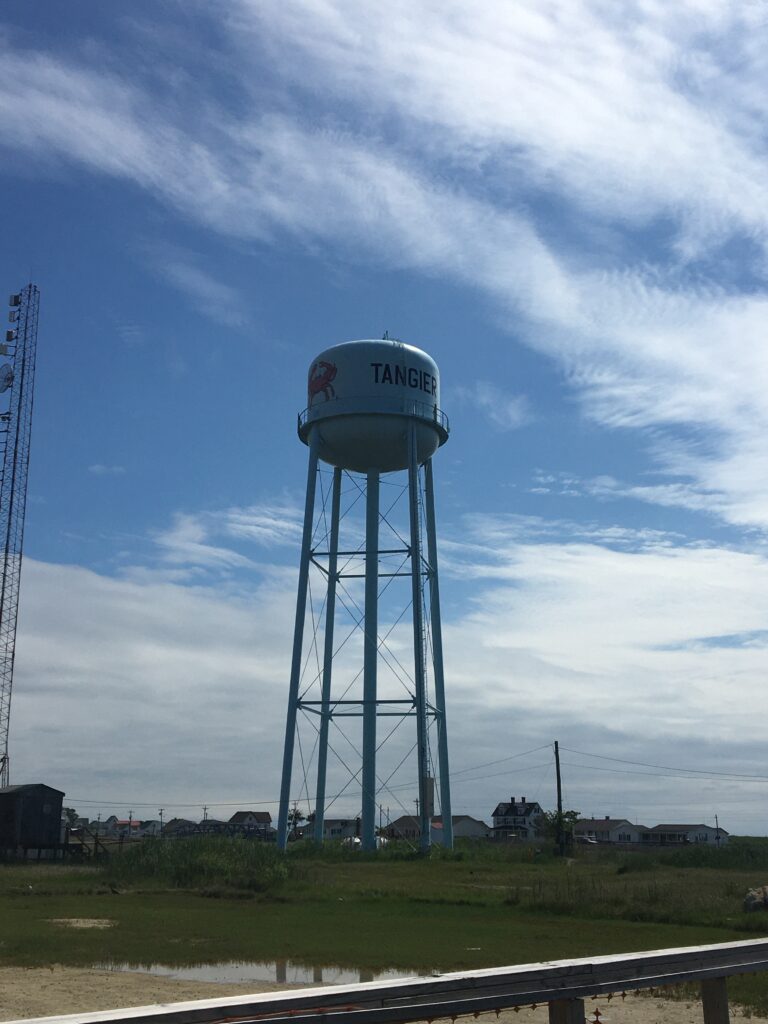
“We know Tangier has to compete with other projects,” Tangier town manager Renee Tyler tells New York Times reporter Jon Getner when asked about the Tangier’s attempts to persuade the Army Corps of Engineers to help out with a project to save the island. This military engineering branch are often the people who undertake projects such as these. “But we feel — I don’t know, is ‘inconsequential’ the right word? We feel that we’re not a priority, that we’re too small to make a difference.”2
With so many different coastal communities – most of which are either more populated than Tangier or possess more economic value – in danger of being submerged by the ocean in the future, the line for government support is very long, and sadly for Tangier, many of these communities either have more people at risk, or possess economic value to the government that Tangier does not. Take the island of Poplar, for example. Once in a similar position to Tangier, Poplar was abandoned due to similar issues that might lead to Tangier’s abandonment. By the 1990s it had been reduced to a tiny sandbar. However, even that tiny island took priority over Tangier for government expenditure, with Maryland spending over $1.4 billion overall to have it restored by 20403. Why? Because Poplar had economic value – its location as an island preserves the port of Baltimore, a huge driver of Maryland’s economy4 – Tangier has no such use.
Even if Tangier had a compelling case to be considered over some other projects, it still isn’t a guarantee that they would actually get funding they need. In order for the Army Corps projects to get approved, there needs to be a new bill passed, called a Water Resources and Development Act bill5. The problem with this is that many Congressmen have their own agendas and projects that they would like to see on the top of the priority list for the Corps to tackle. With this in mind, another layer of doubt as to whether Tangier will ever get help is added.
Even still, if all goes perfect, and Tangier does get its water break system put in place, and its dreams do come true, there still remains some doubt as to whether this solution is permanent. After all, the Chesapeake Bay experiences above average relative sea level rise, and even if a break water system is successfully implemented, and the man made dunes are erected, there’s no telling if it will truly preserve the Island.
With all this in mind, you cannot fault someone who may think the island is too far gone to recover. This is especially true when you consider that the island does not have much time until it has to be abandoned. With climate change rapidly accelerating, projections look bleaker and bleaker with each passing year. And as the clock keeps ticking, Tangier gets smaller and smaller.
- Jon Gertner, “Should the United States Save Tangier Island from Oblivion?” The New York Times, July 6, 2016, accessed December 4, 2024, https://www.nytimes.com/2016/07/10/magazine/should-the-united-states-save-tangier-island-from-oblivion.html. ↩︎
- Gertner, “Should the United States Save Tangier Island from Oblivion?” ↩︎
- Gertner, “Should the United States Save Tangier Island from Oblivion?” ↩︎
- Gertner, “Should the United States Save Tangier Island from Oblivion?” ↩︎
- Gertner, “Should the United States Save Tangier Island from Oblivion?” ↩︎